Flight Physiology: Anatomy of the Human Ear video
An educational 3D animation exploring the anatomy and function of the human ear as it relates to aviation physiology, featuring a detailed fly-through of auditory and vestibular structures critical to pilot spatial orientation and hearing protection.
- Client
- UVU Aviation
- Year
- 2011
- Role
- 3D artist
- Category
- eLearning, 3D
- Technologies
- Maya, Adobe Illustrator
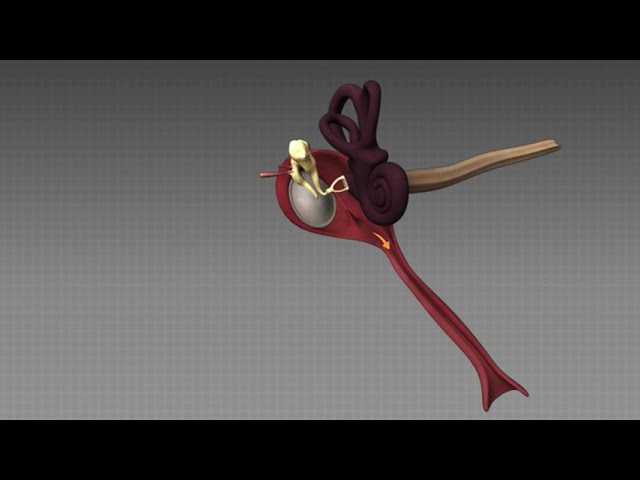 This instructional animation was created to support aviation physiology training, taking viewers on an immersive journey through the human ear to understand why this organ is so critical to flight safety. The presentation covers both the auditory system responsible for hearing and the vestibular system that governs balance and spatial orientation—two functions that can significantly impact pilot performance.
The animation begins at the external ear (pinna) and progresses through the external auditory canal to the tympanic membrane, illustrating how sound waves are funneled and focused toward the eardrum. Viewers then explore the air-filled middle ear cavity, examining the three ossicles—malleus, incus, and stapes—and learning how these tiny bones amplify vibrations before transmitting them to the inner ear. The role of the eustachian tube in pressure equalization is explained, along with the consequences of dysfunction known as "ear block."
The inner ear section showcases detailed 3D models of the cochlea and semicircular canals. The fluid-filled cochlea's frequency-mapping structure is demonstrated, explaining how repeated exposure to high-intensity noise leads to hearing loss in specific frequency ranges. The semicircular canals are presented as the body's gyroscopic instruments, with their three-axis orientation enabling detection of acceleration and motion. The animation concludes by explaining how vestibular nerve adaptation can create dangerous spatial disorientation illusions like the graveyard spiral—essential knowledge for any pilot.